An MS Word version of this document.
The Excel work that went with this document.
1. We
find arc length for  ,
,  . Simpson's Rule. n =
10.
. Simpson's Rule. n =
10.

 , using Excel
. Using Maple, Simpson's rule yields 1.732215082,
which differs in the last digit. I'd
lean toward Maple being more precise, because its purpose is to get its hands
dirty on problems like this and Excel is a Microsoft product. :o)
, using Excel
. Using Maple, Simpson's rule yields 1.732215082,
which differs in the last digit. I'd
lean toward Maple being more precise, because its purpose is to get its hands
dirty on problems like this and Excel is a Microsoft product. :o)
As near as Maple can tell, the value is 1.732214672.
2. We
find the surface area when  is revolved about the x-axis, from x = 1 to x = 2. To accomplish this, we evaluate the integral
 , with Simpson's Rule, n
= 10.
, with Simpson's Rule, n
= 10.
When I used Maple with Simpson's Rule, I obtained 29.50656628.
When I used Excel, I obtained 29.50656629, again differing in the last digit, only.
As near as Maple can tell, the value is 29.50656808.
3. Force of Pressure on the end-wall of a trough with an equilateral triangular cross-section, with the dimensions shown in the diagram, below.
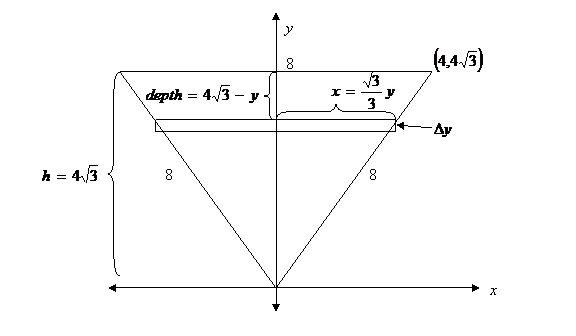
We implement the following integral:
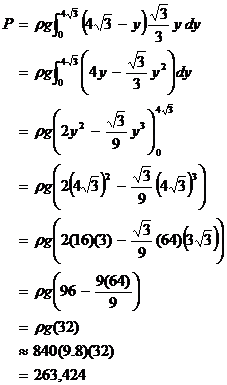
This gives HALF of the pressure, since the width I used was
just the x-value associated with a
given depth,  . So, the final answer
is approximately 526,348 N.
. So, the final answer
is approximately 526,348 N.
Dimensional Analysis:
 . This gives
 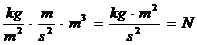 , as we would hope and expect. :o)
4. We
solve the logistic equation 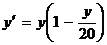 :
:
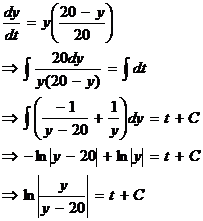
For the purposes of the Logistic Model, we're assuming that
0 < y < 20, with y = 20 being the carrying capacity of
the environment. With this assumption,
we see that  must be negative, so that
 where k =
  . Continuing this line
of reasoning:
. Continuing this line
of reasoning:
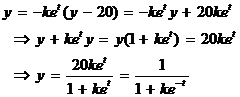
This all changes when  , which leads to a sign change:
 amounting to
  . With the first version,
we arrive at the conclusion that k < 0 in the case. A discerning student would say that this is
ridiculous, considering the definition of k as , which is positive.
But with this little digression, we see that all is well.
. With the first version,
we arrive at the conclusion that k < 0 in the case. A discerning student would say that this is
ridiculous, considering the definition of k as , which is positive.
But with this little digression, we see that all is well.
 . This degenerate case
doesn't really fit the solution we found, since it's impossible to make y(t)
= 0. But considering the differential
equation, we see that y identically
zero is as solution, and the
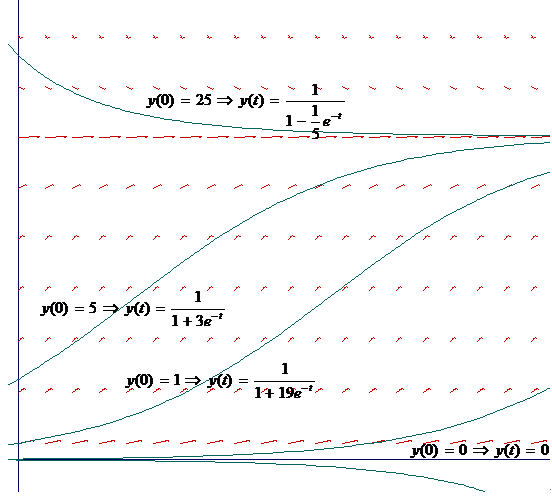
direction field, below, confirms that the only solution containing y(0) = 0 is the null solution.
. This degenerate case
doesn't really fit the solution we found, since it's impossible to make y(t)
= 0. But considering the differential
equation, we see that y identically
zero is as solution, and the
direction field, below, confirms that the only solution containing y(0) = 0 is the null solution.
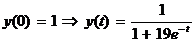
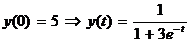
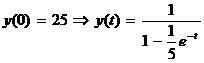 , which fits the theory
of the differential equation, but the
mathematical theory doesn't fit reality, since the model says that starting
above the carrying capacity leads to
a strictly decreasing solution that stays above
the carrying capacity!!! In real
life, this wouldn't happen. More like,
there'd be catastrophic die-off, and, as in nature, the population would
fluctuate in the vicinity of the carrying capacity.
, which fits the theory
of the differential equation, but the
mathematical theory doesn't fit reality, since the model says that starting
above the carrying capacity leads to
a strictly decreasing solution that stays above
the carrying capacity!!! In real
life, this wouldn't happen. More like,
there'd be catastrophic die-off, and, as in nature, the population would
fluctuate in the vicinity of the carrying capacity.
Nature's creatures aren't blessed with an innate sense of balance. They're just geared to survive as long as possible and to have as many babies as possible... ;o)